
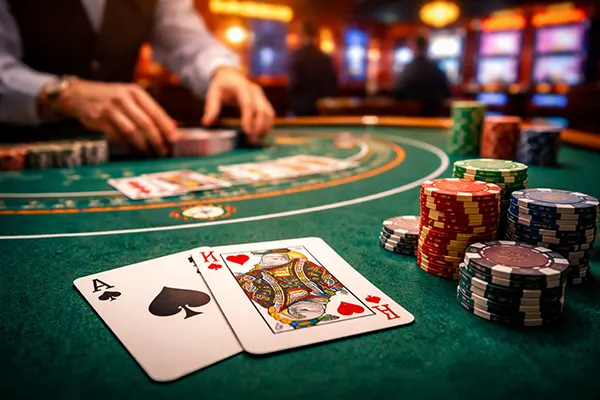
Blackjack Rules: Small Details That Shift the House Edge
Blackjack remains one of the few casino games where informed decisions genuinely affect long-term results. Yet many players focus on basic strategy charts and overlook the subtle rule variations that quietly increase or reduce the house edge. In 2026, both land-based and online casinos continue to adjust blackjack conditions in ways that may seem minor at first glance. However, changes in payout ratios, deck numbers or doubling rules can alter the mathematical balance far more than most players realise. Understanding these nuances is essential for anyone who wants a realistic view of expected returns rather than relying on assumptions.
Blackjack Payout Ratios and Their Real Impact
The single most significant rule variation in blackjack is the payout for a natural blackjack. Traditionally, a blackjack pays 3:2, meaning a £10 stake returns £15 in profit. Under optimal basic strategy, a standard 3:2 game with favourable rules can offer a house edge of around 0.3% to 0.6%, depending on deck count and other conditions.
However, many modern tables — particularly online and in high-traffic casinos — now offer 6:5 payouts. This seemingly small change increases the house edge by approximately 1.4%. In practical terms, that single adjustment alone can push the edge above 1.8% or even 2%, making the game more expensive than several other table options.
Some hybrid or live dealer tables have also introduced variable payout structures tied to side bets or promotional mechanics. While these may appear attractive, the base payout ratio remains the primary driver of long-term expectation. For serious analysis, the payout percentage should always be the first rule examined.
Dealer Behaviour: Stand or Hit on Soft 17
Whether the dealer stands or hits on soft 17 (a hand containing an Ace counted as 11) directly influences expected returns. If the dealer stands on soft 17, the house edge is slightly lower. If the dealer hits soft 17, the edge increases by roughly 0.2%.
This adjustment may seem marginal, yet over thousands of hands it meaningfully shifts expected loss. In 2026, a significant number of online blackjack tables operate under “dealer hits soft 17” rules, particularly in multi-deck formats.
When combined with 6:5 payouts, the hit-on-soft-17 rule compounds disadvantage. A table that includes both conditions becomes mathematically less favourable than a classic 3:2, stand-on-soft-17 configuration, even if all other rules appear standard.
Number of Decks and Penetration Depth
The number of decks used in blackjack affects both the house edge and the feasibility of advanced techniques such as card counting. A single-deck game under favourable rules can reduce the house edge to below 0.2% when optimal strategy is applied. By contrast, eight-deck shoes typically increase the edge by approximately 0.5% compared to single-deck equivalents.
More decks dilute the probability of drawing specific high-value cards, slightly favouring the dealer over time. Although casinos often justify multi-deck shoes for operational efficiency, from a statistical standpoint they subtly erode player advantage.
Penetration depth — how much of the shoe is dealt before reshuffling — also matters. In physical casinos, deeper penetration benefits skilled counters. In online RNG blackjack, reshuffling occurs after every hand, eliminating this factor entirely and maintaining a consistent house edge.
Resplitting and Doubling Restrictions
Rules governing doubling down and splitting pairs introduce further variation. The ability to double on any two cards is more favourable than doubling restricted to totals of 9, 10 or 11. Restrictive doubling increases the house edge by around 0.1% to 0.2%.
Resplitting pairs, particularly Aces, significantly influences expected return. If players may resplit Aces, the edge decreases slightly. If splitting Aces allows only one additional card and no further action, the advantage shifts back towards the house.
Even small procedural constraints — such as prohibiting double after split (DAS) — can add another 0.15% or more to the house edge. When combined, these minor restrictions accumulate, often pushing a seemingly standard table well beyond a 1.5% disadvantage.
Insurance, Side Bets and Hidden Costs
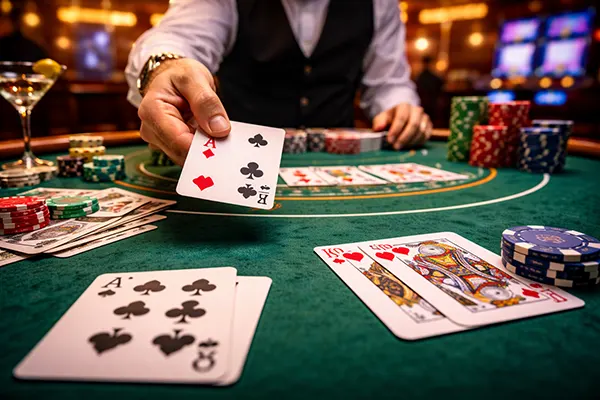
Insurance is frequently misunderstood. Mathematically, insurance carries a house edge of roughly 7% to 8% in standard multi-deck games. Unless a player is tracking deck composition with high accuracy, taking insurance consistently increases long-term losses.
Side bets such as Perfect Pairs or 21+3 typically hold house edges between 3% and 10%, depending on the specific variant. Although they may deliver occasional large payouts, their volatility masks a structurally higher cost compared to the main blackjack wager.
In 2026, many live dealer tables prominently promote side bets, integrating them visually into the betting layout. While optional, their positioning encourages frequent use. From a statistical perspective, they represent one of the most significant hidden contributors to overall player loss.
Rule Combinations and Cumulative Effect
Each individual rule change may appear minor in isolation. A 0.2% increase here, a 0.15% increase there — these increments feel negligible during short sessions. However, blackjack is a high-volume game where hundreds of hands can be played in a single evening.
When a table combines 6:5 payouts, dealer hits soft 17, eight decks, no double after split and restricted resplitting, the cumulative house edge can exceed 2%. That level approaches the cost structure of less skill-dependent games.
The key principle is simple: evaluate blackjack conditions holistically. The advertised minimum bet or visual presentation tells little about expected value. Only by examining payout ratios, deck count, dealer rules and action restrictions together can the real mathematical balance be understood.